Getting DSM Cited by Google's AI Overview and ChatGPT Through Project Content
Case study: SEO and GEO for PT Damai Sejahtera Metalindo, where project and guide content got DSM cited in Google's AI Overview and mentioned by ChatGPT.
- Client
- PT Damai Sejahtera Metalindo
- Role
- SEO & GEO Specialist
- Tools
- WordPress, All in One SEO, Structured data (JSON-LD), Google Search
After PT Damai Sejahtera Metalindo's website went live, the next question was: how does DSM show up when a prospective client searches for the service on Google, or asks an AI for a recommendation?
I worked on SEO and GEO (Generative Engine Optimization, getting content cited in AI answers) for dsmetalindo.com. The focus was two things: project content and guide articles written from DSM's real experience, plus clean on-page SEO and structured data. The result: DSM got cited in Google's AI Overview and mentioned by ChatGPT for searches relevant to its services.
The problem: how people search for vendors has changed
Engineering and procurement teams no longer just open a list of blue links on Google. Many searches are answered directly by AI Overviews right at the top, and more and more people ask ChatGPT directly, for example "recommend a gas pipe installation company in Cikarang."
That AI answer is assembled from the pages judged to answer the question most clearly. An industrial website with nothing but a short list of services rarely has enough material to be cited. So the challenge isn't just "ranking on page one," it's having content specific and trustworthy enough to be used as a source.
The approach: SEO fundamentals, not AI-specific tricks
A lot of people assume GEO needs special files or markup. But in its AI features and your website documentation, Google states there are no additional requirements or special optimizations for appearing in AI Overviews and AI Mode. What it recommends is still SEO fundamentals: pages that can be crawled, important content available as text, easy to find through internal links, and structured data that matches the visible text on the page.
So I focused on what could actually be controlled:
- 1Project contentReal case studies with technical detail
- 2Guide articlesAnswering what prospective clients search for
- 3On-page & schemaTitle, meta, headings, and JSON-LD
- 4Internal linksEvery page connects to other projects
What I worked on
The project portfolio as case studies
I wrote every DSM project as its own page with the same structure: About the Project, Scope of Work, and Project Results. It's filled with detail that could only come from a project actually completed: the type of gas, the pipe material, the length of the line, and the testing process before handover.
One example is the VJ Line (Vacuum Jacketed Line) installation project, a roughly 60-meter cryogenic pipeline from a liquid oxygen tank to a production room, fabricated at the local workshop. Specifics like this are exactly what Google looks for when it evaluates first-hand experience in its creating helpful content guide.
There are now 17 project and article posts on the DSM website, and every post has its own meta description naming the work and its scope, not the same generic sentence repeated on every page.
Guide articles that answer prospective clients' questions
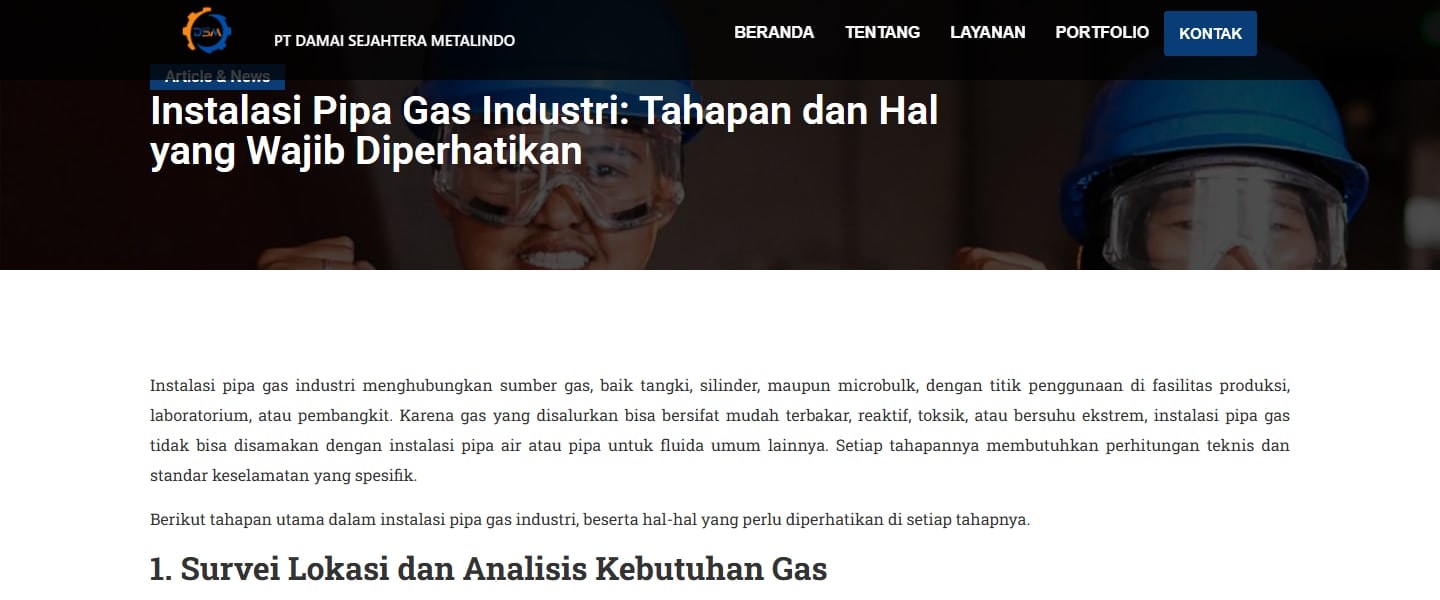
Beyond the portfolio, I wrote articles answering common questions in the industry, for example Industrial Gas Pipe Installation: Stages and What to Pay Attention To. The article is organized into numbered stages, from site survey and route design to installation, testing, and commissioning. A structure like this is easy for readers to follow and easy for search engines to summarize.
On-page SEO and structured data
- Page titles naming the service and location, for example the services page titled "Machining, Fabrication, MRO & Gas Pipe Installation Services Cikarang."
- One H1 per post with subheadings in a logical order, so the page's content is easy to map out.
- Clean canonicals and a sitemap through All in One SEO.
- JSON-LD structured data for Organization, BlogPosting, and BreadcrumbList. According to Google's structured data guide, this markup gives explicit clues about what a page means.
Internal links between projects
Every project and article page shows other projects further down, so search engines can crawl through all of DSM's content from any page, and readers have a reason to keep browsing the next project.
Results
Cited in Google's AI Overview for a technical term
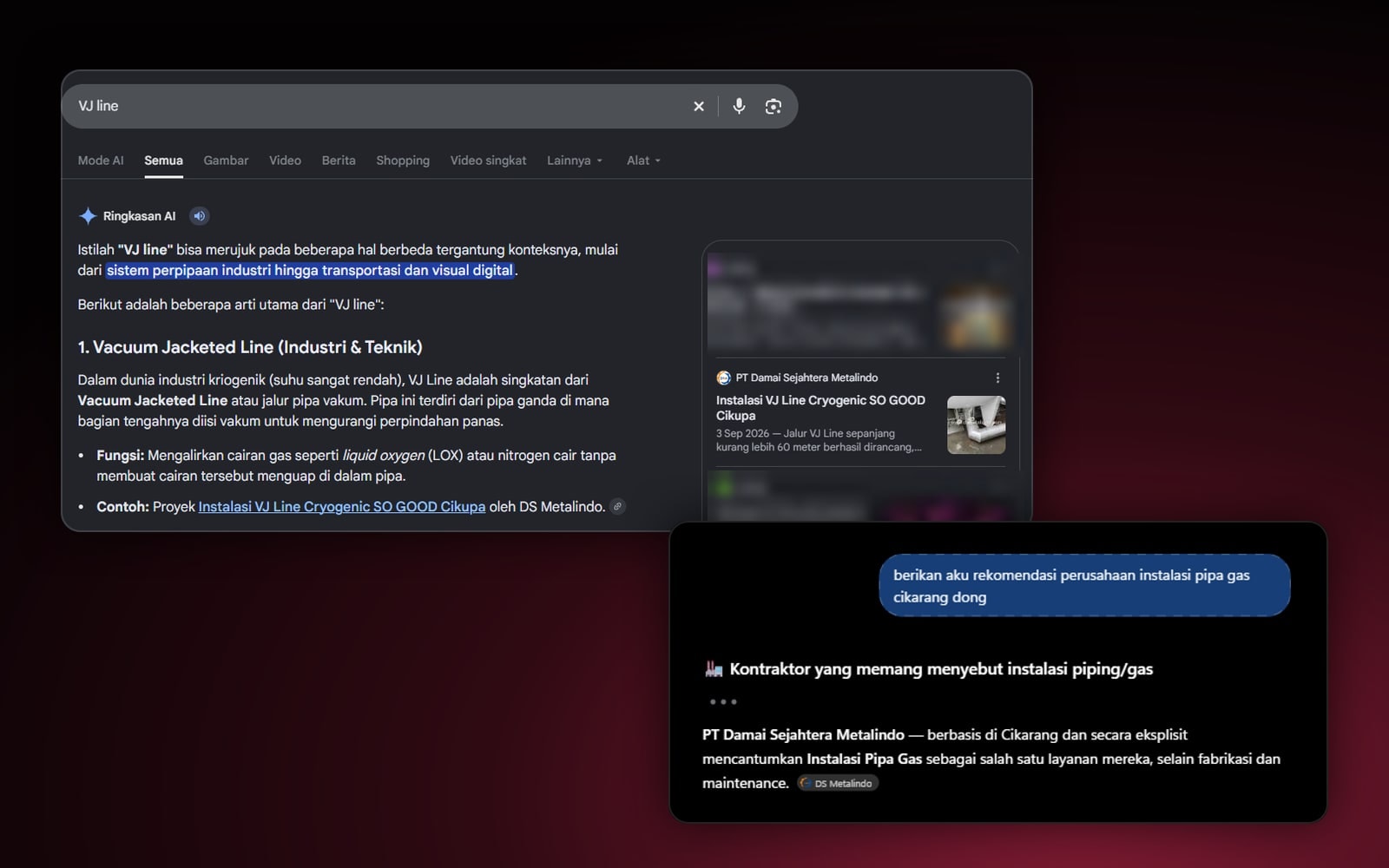
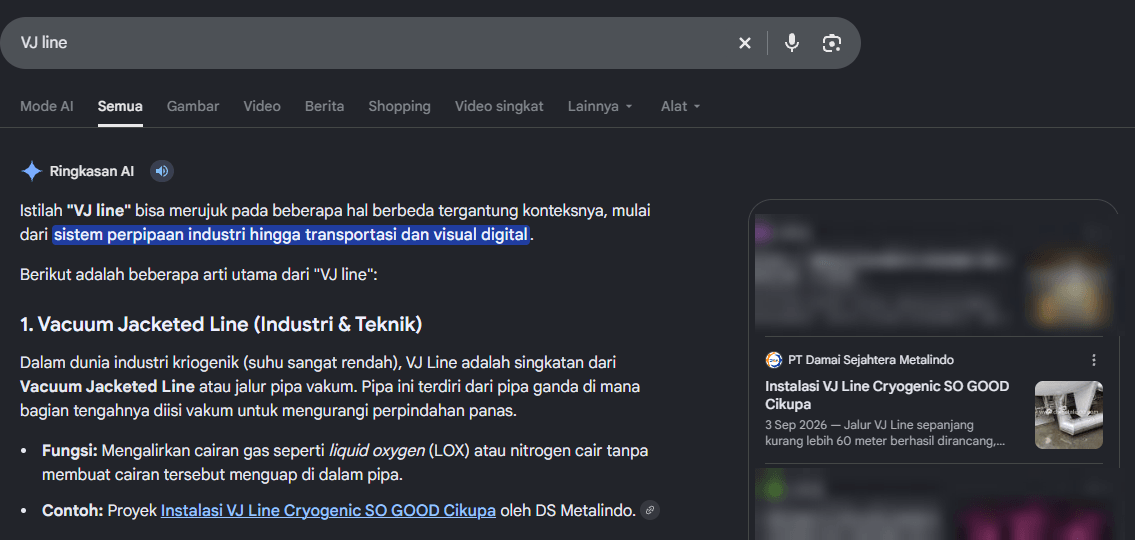
When people search "VJ line," Google's AI Overview explains the Vacuum Jacketed Line term and uses the DSM project as an example, complete with a link to the project page. A DSM source card also appears on the right side.
Cited for location-based service searches
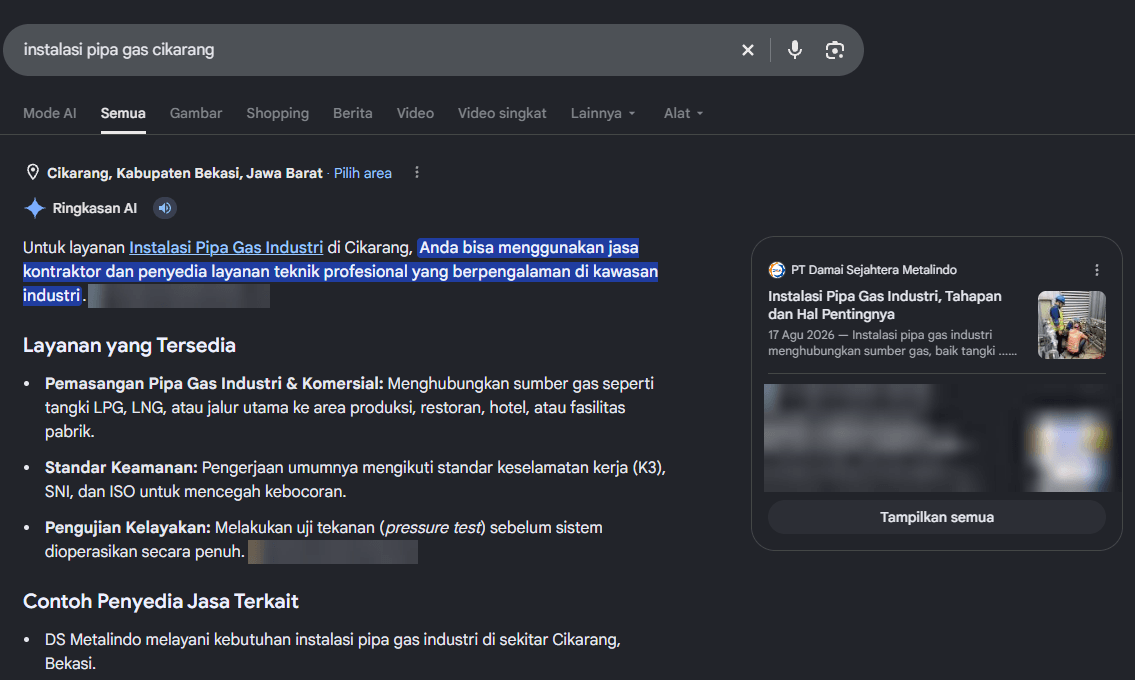
For the search "instalasi pipa gas cikarang" (Indonesian for "gas pipe installation cikarang," the query DSM's real customers actually type), the AI Overview pulled DSM's guide article as a source, and named DSM in the section on example service providers.
Named by ChatGPT as a gas pipe contractor in Cikarang
When ChatGPT was asked to recommend gas pipe installation companies in Cikarang, DSM showed up among the contractors explicitly offering gas pipe installation.
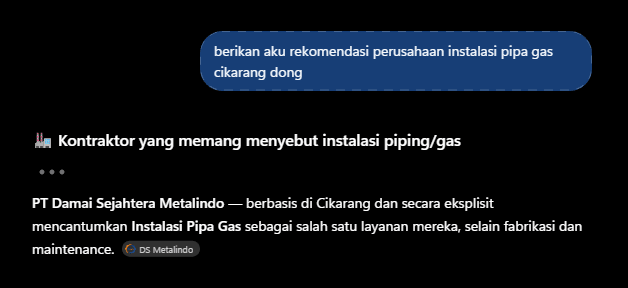
- Google searches where DSM is cited in the AI Overview
- 2
- Project and guide posts written from real experience
- 17
- Names DSM as a gas pipe installation contractor in Cikarang
- ChatGPT
Lessons
For an industrial services company, the best GEO material already exists: the projects that have actually been done. As long as those projects sit only in an internal archive, Google and AI have nothing to cite. Once they're written up as specific, structured, interlinked pages, that experience turns into an asset that can be found.
Is your team still doing something by hand?
Tell me about it, and let's find the fix together.
More case studies
 AI & Automation
Social media agency
Team Task Reminders Over WhatsApp, Weekly to One-Off, Managed From One Place
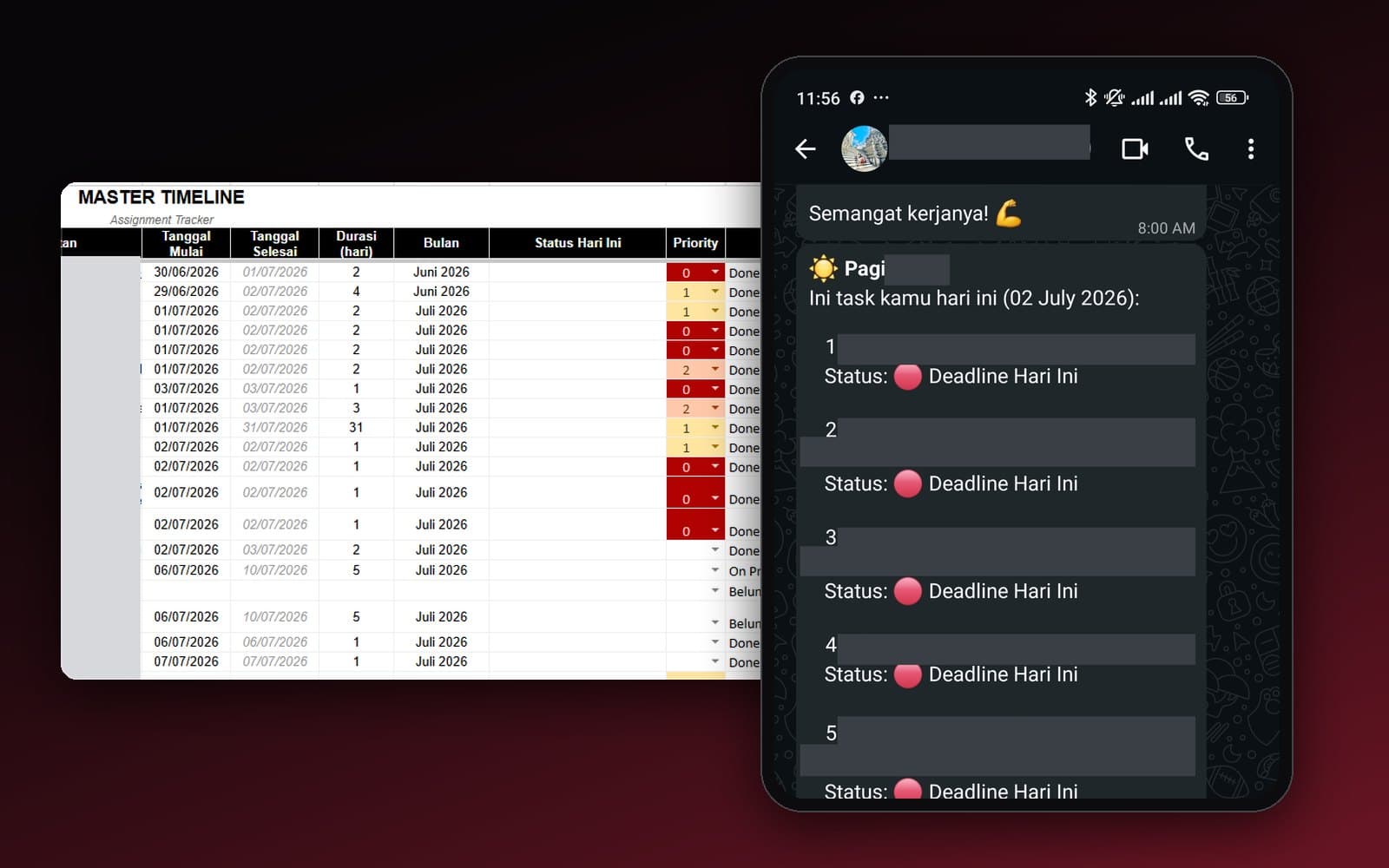
Weekly, monthly, and one-off task reminders sent automatically to the team's WhatsApp every morning, with settings the team can change themselves in the sheet, no developer needed.
Read case study AI & Automation
Retail business
Thousands of WhatsApp Chats, a Two-Person Team: Letting the Owner Monitor Without Reading Everything
The owner gets an automatic recap every night at 9pm covering closed deals, complaints, and follow-ups, without reading every chat one by one.
Read case study