How to Prompt AI in 2026, To the Point
You don't need "hi" and "please". What makes AI answers good is context, format, and clear constraints. Here's the practical prompt engineering I use in 2026.

How to prompt keeps changing with every new model. Take the habit of writing instructions in all caps with forceful words like "CRITICAL: You MUST…" to make AI comply. In its own official guidance, Anthropic now actually recommends toning down language that aggressive, because newer models are more responsive to the system prompt, so instructions that strong can make the model overreact.
In this article I round up the prompt engineering practices that still hold up in 2026. Prompt engineering here simply means: deliberately designing instructions to AI so the output is predictable and repeatable, not just accidentally good.
"Hi," "please," "thank you" aren't necessary
AI has no feelings to protect. To a model, words like "hi," "sorry to bother you," "please," and "thanks so much" are just ordinary tokens getting processed along with everything else. They lengthen the prompt without adding any information about the task.
The research on this is interesting too. The Mind Your Tone study from Penn State tested 50 multiple-choice questions (math, science, history), each rewritten across five politeness levels, then ran them 10 times each on ChatGPT-4o. The result was the opposite of what most people would guess:
Answer accuracy by prompt tone(% correct)
- Very polite80.8%
- Polite81.4%
- Neutral82.2%
- Rude82.8%
- Very rude84.8%
But don't jump to "AI performs better if you're rude to it." The gap is only 4 points, on one model, with 50 questions, and the researchers themselves flag that dataset size as a limitation. A follow-up study, Does Tone Change the Answer?, tested GPT-4o mini, Gemini 2.0 Flash, and Llama 4 Scout and found the tone effect varies by model, shrinking to the point of losing significance once you look across many task types.
My takeaway from both studies: tone isn't the main lever. You don't need to be rude, but you don't need small talk either. A direct sentence with the verb up front, like "Write…," "Analyze…," or "Summarize…," makes the instruction clearer for the model, and easier for a human to reread too.
What matters is context, not politeness
If tone doesn't move the needle much, what does? The answer is context.
In its official prompting guide, Anthropic recommends treating AI like a smart new hire who doesn't yet know your habits and workflow. The more precisely you explain what you want, the better the result. They also give a simple test: show your prompt to a coworker who doesn't know the context. If they're confused, the AI will be too.
Distinguish between two kinds of additions in a prompt:
- Filler lengthens the prompt without changing the content of the answer. Example: "make it good," "keep it really professional," "this is really important."
- Context changes the content of the answer. Example: "this is for a Series D pitch deck to growth-stage investors" produces a very different outline from "this is for an early-stage accelerator application."
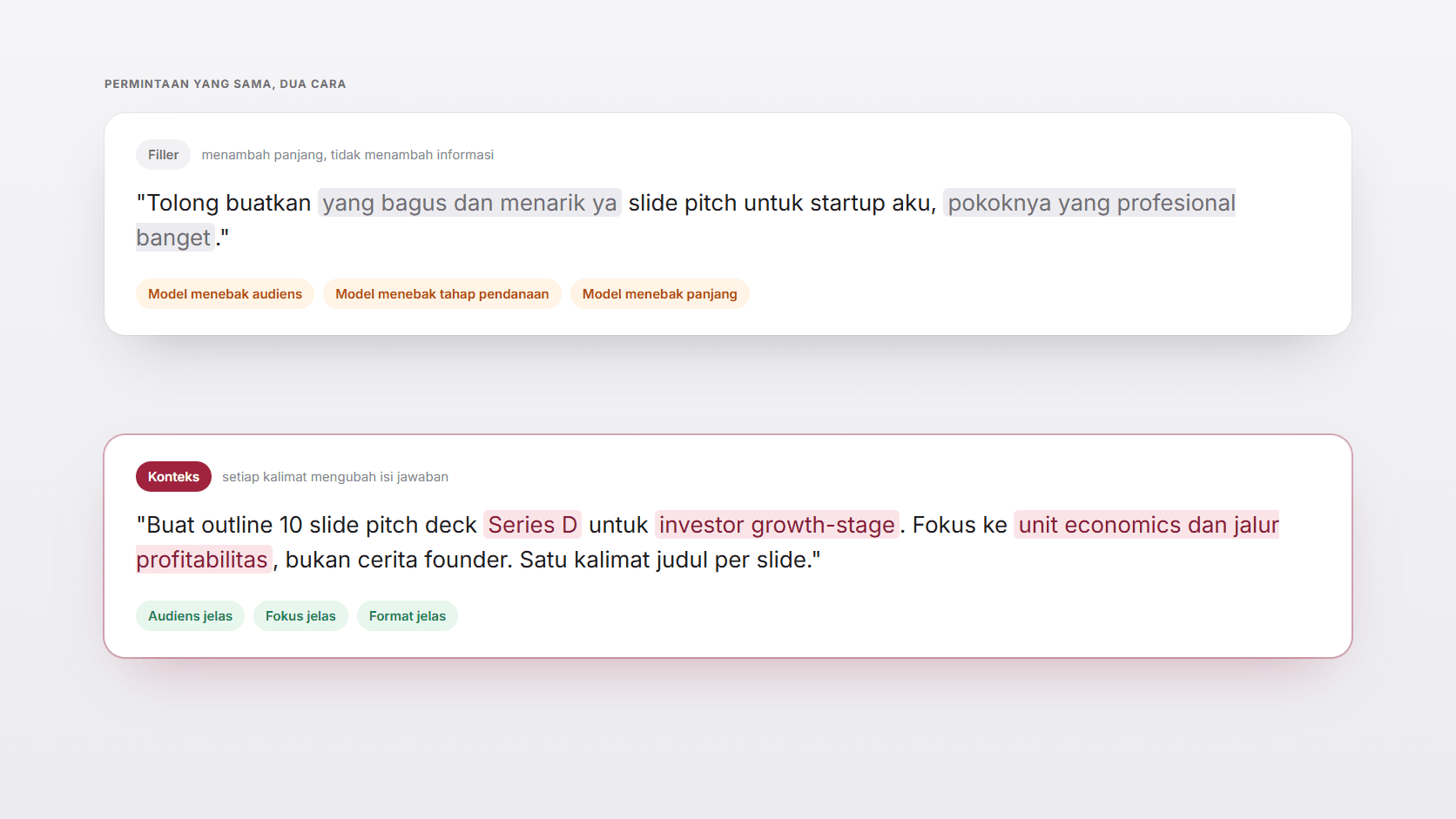
But context also has to be chosen, not just piled on. Research presented at ICML 2023, Large Language Models Can Be Easily Distracted by Irrelevant Context, showed model performance dropping sharply when a question was padded with irrelevant information. So don't just copy-paste an entire document and chat history. Include what the task actually needs.
On "you are a senior expert…"
Giving AI a role is genuinely recommended. Anthropic's guide notes that a role in the system prompt helps focus behavior and tone, sometimes with just one sentence.
But the expectations need adjusting. A study, When "A Helpful Assistant" Is Not Really Helpful, published in Findings of EMNLP 2024, tested 162 personas across 4 model families with 2,410 factual questions. The result: adding a persona to the system prompt did not improve accuracy compared to no persona at all.
So "you are a senior technical writer with 10 years of experience" isn't a magic phrase that automatically makes answers more correct. A role is useful when it carries real context: who the reader is, what standard applies, and what terms should or shouldn't appear.
The prompt framework I use
A reliable prompt usually isn't the longest or most creative one, it's the one with the clearest structure. This is the framework I use for nearly every task:
- The task, starting with a verb. "Summarize the attached report," not "please help me with this report."
- Deliberate context. What it's for, who's reading it, and what the reader already knows.
- A clear output format. JSON, a table, bullets, or a word count. If the format matters, say so explicitly.
- Constraints and edge cases. Allowed values, a maximum length, and what to do when data is missing.
- A role, if relevant. Used to set a point of view and a standard, not as an accuracy charm.
For a prompt that mixes instructions, documents, and examples, Anthropic's guide also recommends wrapping each part in a tag, like <context> and <format>, so the model doesn't confuse instructions with material.
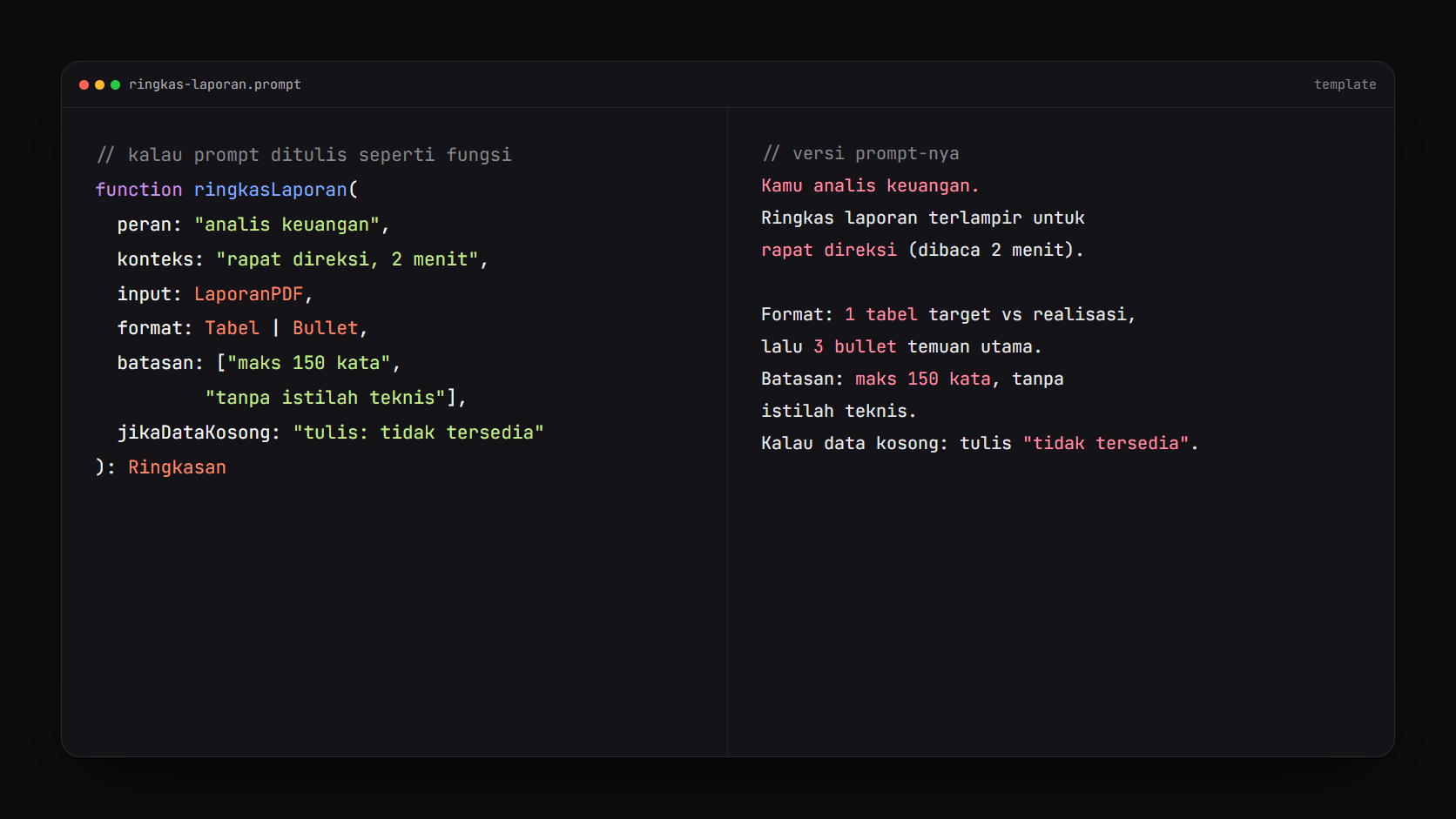
Takeaway: a prompt is a function signature, not small talk
If there's only one thing to remember: write a prompt the way you'd write a function signature. Clear input, clear output, and the edge cases already anticipated. A long paragraph full of small talk might feel polite, but to the model it's just extra text to filter out.
A checklist before hitting Enter:
- The first sentence starts with a verb, not "please" or "hi."
- There's context that changes the answer: what it's for, who it's for.
- The output format is stated.
- Constraints and the empty-data case are handled.
- A role is added only if it carries a clear standard or point of view.
- Irrelevant information has been stripped out.
Save and document prompts that are proven to work with the team, so they don't get lost in one person's chat history. I cover this in A Simple SOP to Keep Company AI a Team Asset.
Is your team still doing something by hand?
Tell me about it, and let's find the fix together.
More notes

Can AI Learn Your Sales Style From WhatsApp Chat History?
Yes, and you usually don't need to train your own model. How to export WhatsApp chats, turn them into a style guide, a ready-to-use prompt, and the customer data risks.
Read the note
Gemini vs ChatGPT for Office Work, Which One Fits Better?
Gemini and ChatGPT can both be used for work, but their strengths differ. A plan price comparison in Rupiah, which suits teams on Google Workspace, and when ChatGPT makes more sense.
Read the note