People Now Ask ChatGPT and Google AI, So Does Your Business Show Up in the Answer?
More customers ask ChatGPT and Google AI directly. How to check whether your business gets named, what you can fix, and examples from two of my projects.

People used to type a keyword into Google and open a few links. Now more of them just ask: "rekomendasi salon Jepang di Sudirman" (recommendations for a Japanese salon in Sudirman, a business district in Jakarta), or "perusahaan instalasi pipa gas di Cikarang" (gas pipe installation companies in Cikarang, an industrial area east of Jakarta). The answer comes back as a summary, and your business name is either in it or it isn't.
In this article I cover how to check, what Google and ChatGPT actually use to decide who gets named, and two examples from projects I worked on.
Why being named in the answer matters
Pew Research Center analyzed the browsing behavior of 900 U.S. adults in March 2025. In the results, people who encountered an AI summary on Google clicked a regular result link in 8% of visits, while those who didn't encounter one clicked in 15% of visits. Clicking a link inside the AI summary itself happened in just 1% of visits to pages that had a summary. And 26% of pages with an AI summary ended with the person leaving the browsing session, compared with 16% for pages with only regular results.
The data is from the US and from 2025, but the direction is clear: when an AI answer appears, regular links get clicked less. So beyond ranking, it also matters whether you're named or cited inside the answer.
First, check whether your business gets named
You don't need any special tool. Just:
- Ask the way a customer would. A keyword, a location, and a need, for example "rekomendasi salon Jepang di Sudirman". Try it in ChatGPT and in Google (AI Overview or AI Mode).
- Record the result. The date, location, the exact question, whether you were named, and which sources were cited. AI answers can differ depending on time, location, and how you ask.
- Repeat with variations: recommendations, comparisons, "how much does it cost", "the best for ...".
- Look at the cited sources. Is it your website, your Google Maps profile, the media, or someone else? That tells you where to fix things.
- Compare with two or three competitors, for your own eyes only.
What's actually used is the same fundamentals
Plenty of tips circulate about special files or markup to appear in AI answers. Google says the opposite in its AI features and your website documentation:
- There are no additional requirements or special optimizations to appear in AI Overviews and AI Mode.
- To be shown as a supporting link, a page must be indexed and eligible to be shown in Google Search with a snippet.
- Good SEO practices remain relevant, and structured data must match the visible text on the page.
- You don't need to create new AI-specific files or markup, and there's no special schema.org structured data you need to add.
- Traffic from AI features is counted in the Search Console Performance report, under the Web search type.
For ChatGPT, OpenAI's help page for publishers says any public website can appear in ChatGPT search, as long as you aren't blocking OAI-SearchBot. According to OpenAI's crawler documentation, that setting is separate from GPTBot, which is used for model training, and robots.txt changes take about 24 hours to take effect. If OAI-SearchBot is allowed, visits from ChatGPT can be tracked in Google Analytics, because ChatGPT adds the utm_source=chatgpt.com parameter to the links it opens.
Two examples from my projects
Two different kinds of business, each cited in a different way.
An industrial services company, cited through project content
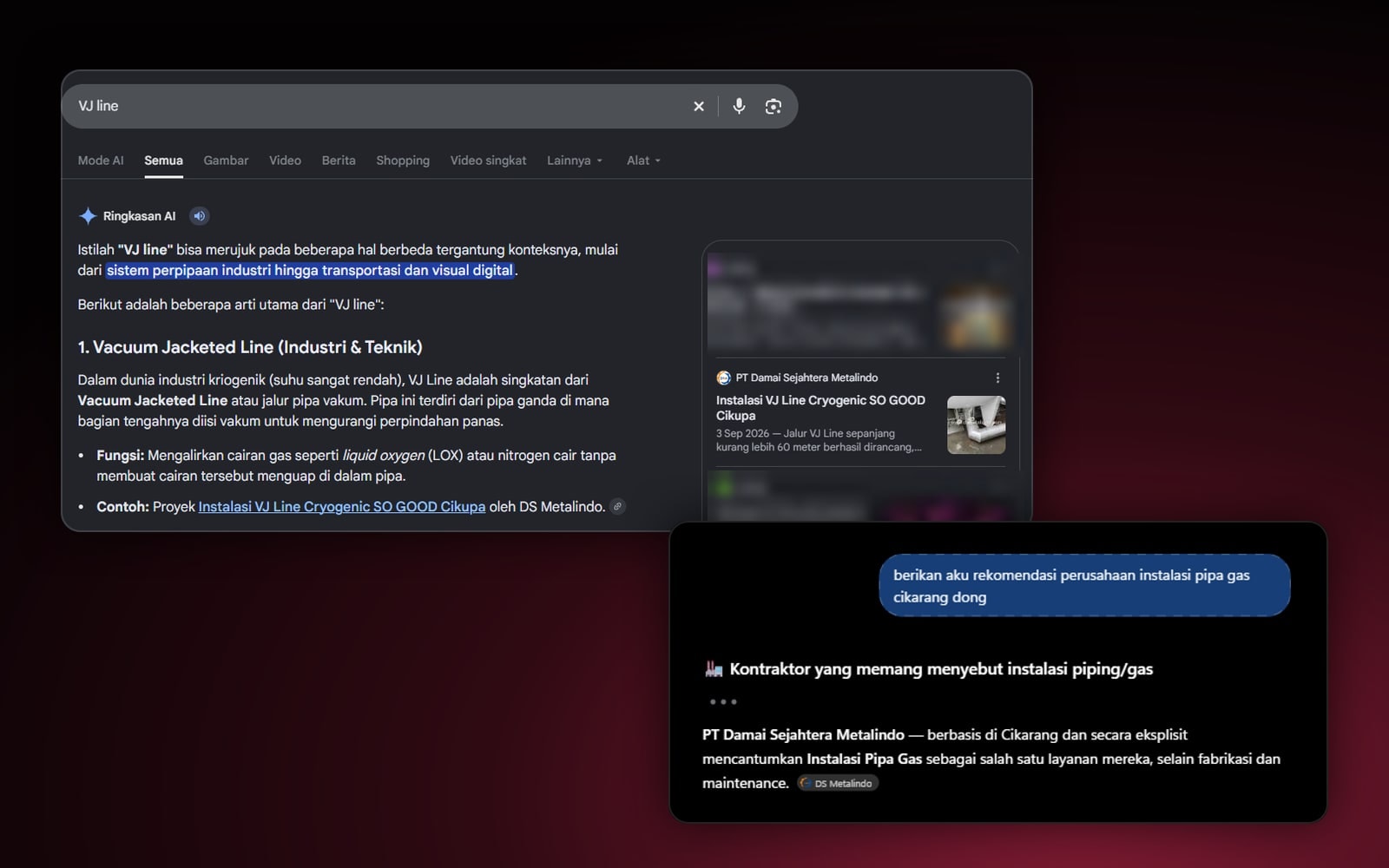
For PT Damai Sejahtera Metalindo (DSM), an industrial services company in Cikarang, I turned every project they had completed into its own page with specific detail, added guide articles that answer prospective clients' questions, and tidied up the on-page SEO and structured data. The result: for the search "VJ line" (vacuum jacketed line, a type of cryogenic pipe), Google's AI Overview used a DSM project as its example. For "instalasi pipa gas cikarang" (gas pipe installation in Cikarang), a DSM guide article became a source, and ChatGPT named DSM among the contractors that explicitly offer gas pipe installation in Cikarang.
A local business, cited through consistent data and a known name
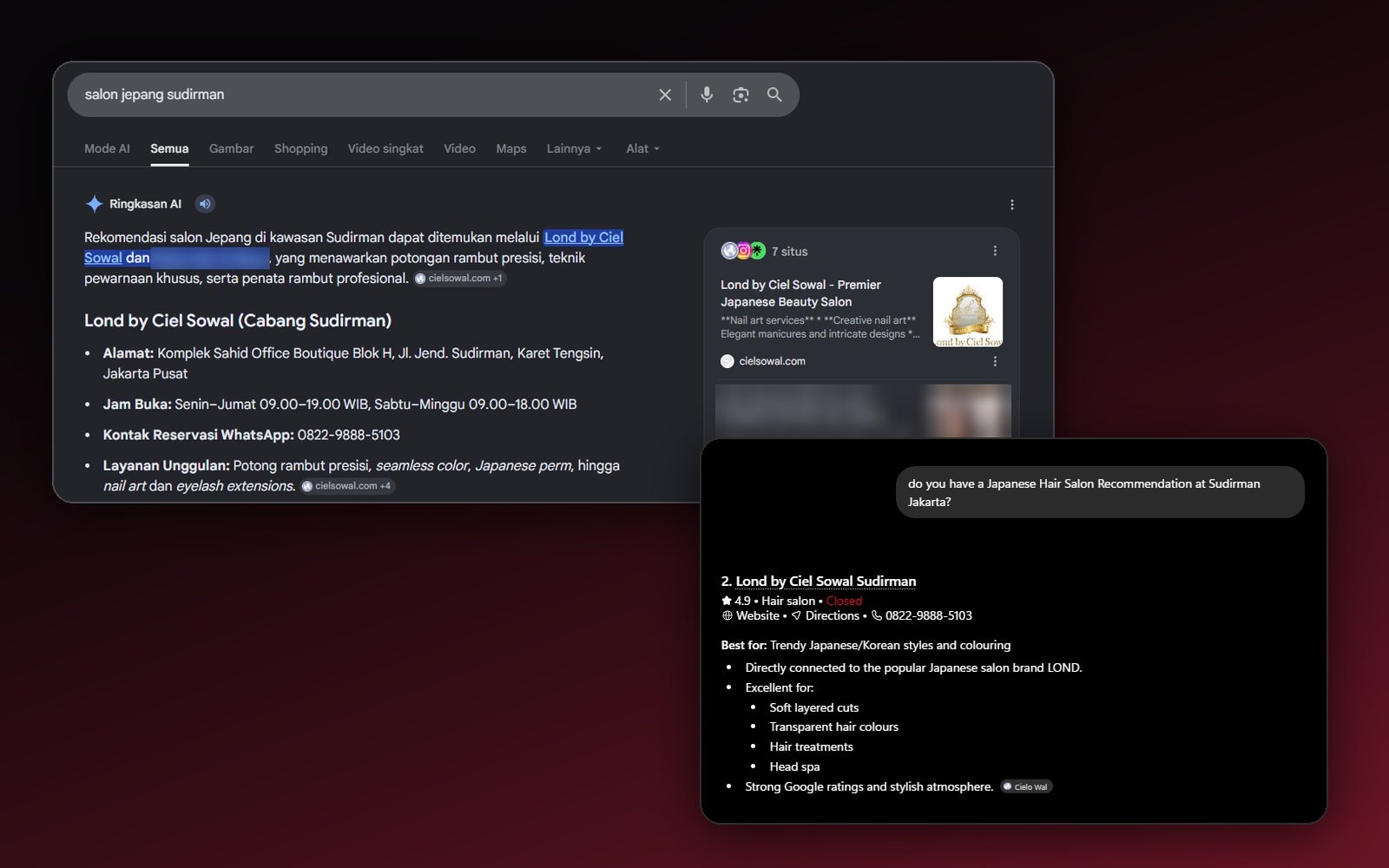
For Lond by Ciel Sowal, a Japanese salon with branches in Japan, Indonesia, and Vietnam, I worked on blog articles, on-page and technical SEO, the Google Business Profile, and press releases to the media. The result: its website appears on page 1 of Google for "salon jepang" (Japanese salon), Google's AI Overview names it first for "salon jepang sudirman" with its address and opening hours, and ChatGPT includes it in its recommendation list with a 4.9 rating, a website link, and a reservation number. Coverage from Kompas.com and Liputan6.com helped build a name people recognize.
The two examples used different material:
| Industrial services (DSM) | Local business (Lond by Ciel Sowal) | |
|---|---|---|
| What customers search for | Technical terms and services, plus location | Recommendations, plus location |
| Main material | Specific project pages and guide articles | A consistent Google Maps profile, reviews, media coverage, and blog articles |
| What the AI cites | DSM's project pages and articles | The website and business data: address, opening hours, rating |
| The lesson | Projects sitting in an internal archive can't be cited, but projects written up as pages can | Consistent data and a known name make a business easier to name |
For local businesses, Google's local ranking guide says local results are mainly based on relevance, distance, and prominence, and that prominence is also based on how many websites link to your business and how many reviews you have. Businesses with complete and accurate info are also more likely to show up in local search results.
What you can fix now
This combines the documentation above with my experience on those two projects:
- Make sure your important pages can be crawled and indexed. Check in Google Search Console.
- Don't block
OAI-SearchBotin robots.txt if you want to appear in ChatGPT search.GPTBotfor model training is a separate setting. - Complete your Google Business Profile, and match it to your website: name, address, opening hours, phone number, and services.
- Write content from real experience. Project case studies, specific answers to questions customers often ask, not generic text.
- Build mentions outside your own website: media coverage, directories, and customer reviews.
- Use structured data as needed, and make sure it matches the text visible on the page.
- Measure. Search Console for Google, and in Google Analytics look for referrals from
chatgpt.com. - Recheck every month with the same questions, and keep notes.
When you check, also look at the phone number shown for your business. Scammers can use the same approach to slip fake numbers into AI answers, as I describe in Asked AI Overview for a Call Center Number, Got Connected to a Scammer.
What I can't promise
I can't promise your business will definitely appear in AI answers. Results differ depending on time, location, and how the question is asked, which is also what I noted in both case studies. What can be done is the foundation, and that same foundation helps regular SEO too. If someone promises "you'll definitely show up in ChatGPT", ask how, and the other questions worth asking are in Before Buying AI Services for Your Company, Here Are the Questions to Ask the Vendor.
Wrapping up
The way people find businesses is shifting from a list of links to an answer. The good news is that what's needed is still the same: a clear website, consistent business data, content that comes from real experience, and a name that's known outside your own website.
If you want to know whether your business gets named today, and what to fix first, tell me about your business first.
Is your team still doing something by hand?
Tell me about it, and let's find the fix together.
More notes

Can AI Learn Your Sales Style From WhatsApp Chat History?
Yes, and you usually don't need to train your own model. How to export WhatsApp chats, turn them into a style guide, a ready-to-use prompt, and the customer data risks.
Read the note
Gemini vs ChatGPT for Office Work, Which One Fits Better?
Gemini and ChatGPT can both be used for work, but their strengths differ. A plan price comparison in Rupiah, which suits teams on Google Workspace, and when ChatGPT makes more sense.
Read the note